
Ingrown Toenail: Causes, Home Care, and When to See a Podiatrist in Salt Lake City
An ingrown toenail might seem like a minor inconvenience, but without proper treatment it can quickly become a painful — and even serious — problem. If your toe is red, swollen, tender, or draining, this is your body signaling that something needs attention. Here is what you need to know about ingrown toenails, what you can do at home, and when it is time to come in.
What Is an Ingrown Toenail?
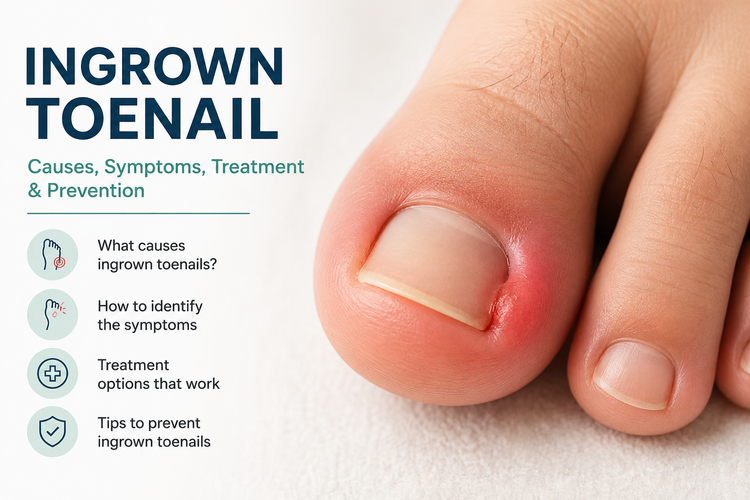
An ingrown toenail occurs when the edge or corner of the toenail grows downward and into the surrounding skin rather than straight out. This causes the skin to become irritated, inflamed, and — if left untreated — infected. The big toe is the most commonly affected, but ingrown nails can develop on any toe.
What Does an Ingrown Toenail Feel Like?
The symptoms typically progress in stages:
- Early stage: Tenderness and mild swelling along one or both sides of the nail
- Moderate stage: Increased redness, warmth, and pain with pressure or wearing shoes
- Infected stage: Pus or drainage, significant swelling, and severe pain — the nail may have a foul odor
Even a low-grade ingrown nail causes enough discomfort to affect how you walk, which can lead to secondary strain in the foot, ankle, and knee over time.
What Causes Ingrown Toenails?
Several factors can cause or contribute to ingrown toenails:
- Improper nail trimming — cutting nails too short or rounding the corners instead of cutting straight across is the most common cause
- Tight or narrow footwear — shoes that crowd the toes push the nail into the surrounding skin
- Nail shape — naturally curved or fan-shaped nails are more prone to growing inward
- Injury or trauma — stubbing a toe or dropping something on the foot can alter nail growth direction
- Genetics — the tendency to develop ingrown nails can run in families
- Repetitive activity — running, hiking, and sports that put repeated pressure on the toes
Home Care: What Can You Try First?
For mild cases — where the nail is tender but there is no sign of infection — conservative home care can sometimes help:
- Soak the foot in warm (not hot) water for 15–20 minutes, two to three times per day
- Gently dry the foot and apply a thin layer of antibiotic ointment
- Wear open-toed shoes or sandals to reduce pressure on the nail
- Trim nails straight across — do not cut down into the corners
- Place a small wisp of clean cotton under the edge of the nail to help guide it away from the skin
Home care has its limits. If symptoms are not improving within a few days, or if there is any sign of infection, do not wait — see a podiatrist.
When Should You See a Podiatrist?
You should schedule an appointment if:
- The toe is red, warm, and swollen — especially if it is spreading beyond the nail area
- There is pus, drainage, or a foul odor
- Home care has not helped after a few days
- The pain is severe or limiting your ability to walk or wear shoes
- You have diabetes, poor circulation, or nerve problems in your feet — even a mild ingrown nail warrants prompt attention in these cases
- You have had ingrown nails in the same toe repeatedly
How Do Podiatrists Treat Ingrown Toenails?
At Salt Lake City Podiatry, we offer fast, comfortable in-office treatment. Most procedures take only a few minutes and patients walk out the same day.
Partial nail avulsion (most common)
The toe is numbed with a local anesthetic, and a thin strip of the nail — just the offending edge — is removed. A chemical is then applied to the nail root to prevent that portion from regrowing. This is a highly effective, permanent solution with a very low recurrence rate.
Conservative nail trimming
For early-stage or mild cases, the ingrown edge can be carefully trimmed without removing the root. This provides immediate relief, though the nail may regrow in the same direction without further intervention.
Antibiotics
If infection is present, oral antibiotics may be prescribed alongside the nail procedure to clear the infection and prevent it from spreading.
Total nail removal
Rarely needed, but for severely damaged or chronically problematic nails, full removal of the nail may be the best long-term option.
How to Prevent Ingrown Toenails
- Cut toenails straight across — never round the corners
- Keep nails at a moderate length — not too short
- Wear shoes with a wide enough toe box to avoid crowding
- Wear protective footwear during activities with a risk of foot injury
- Check your feet regularly, especially if you have diabetes or reduced sensation
Dealing with an Ingrown Toenail in Salt Lake City?
Dr. Zak Oddone provides fast, effective ingrown toenail treatment. Same-day and same-week appointments available at St. Mark's Hospital.
Book an Appointment Call 801-269-9939